
Box sets » Public sector balance sheet

Housing Revenue Accounts had come under increasing financial pressure as rental income failed to keep pace with rising expenditure, contributing to a significant increase in borrowing. In this box, we explored how trends in council housing stock, social rents, construction and maintenance costs, and regulatory requirements affected the financial position of local authorities
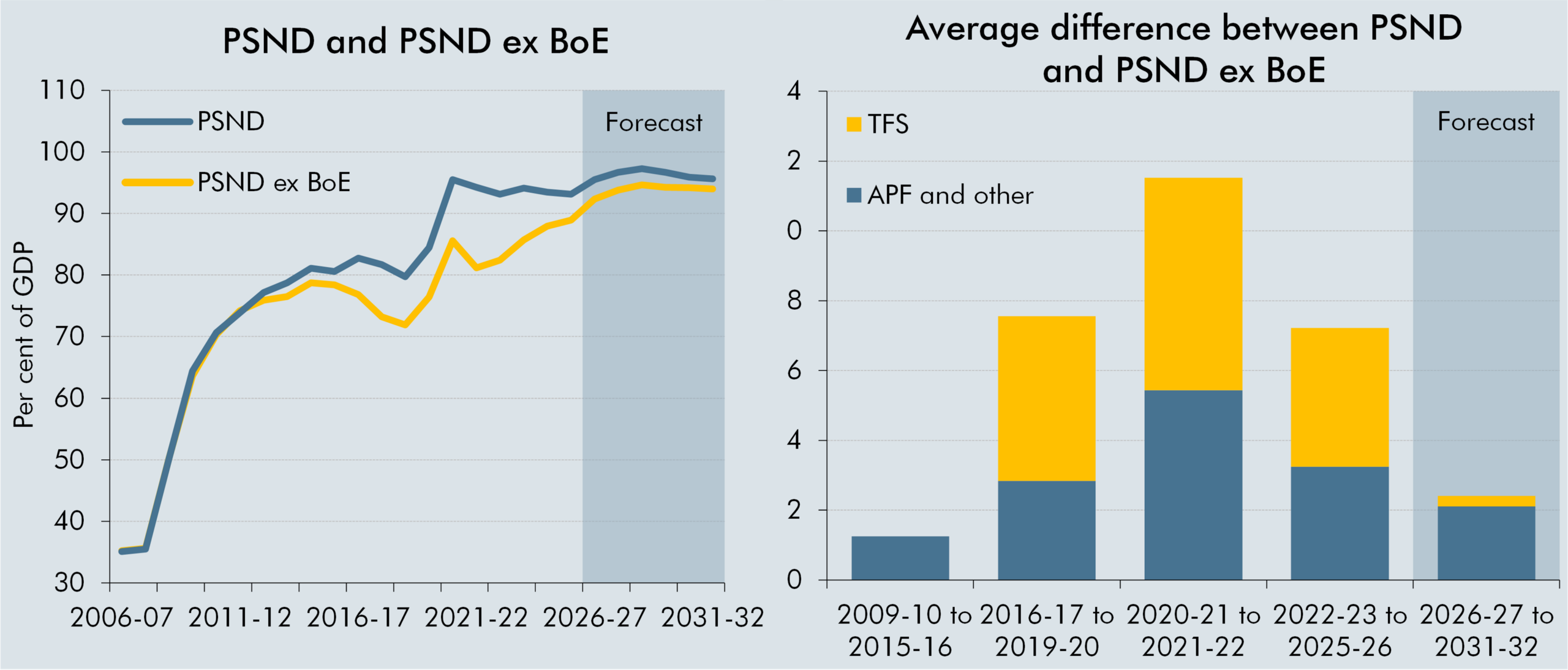
The gap between public sector net debt and public sector net debt excluding the Bank of England widened due to quantitative easing and the Term Funding Scheme, and narrows as these schemes unwind. In this box, we explored how these schemes affected the two measures of debt over time, emphasise how recent falls in PSND have been driven by the unwinding of these schemes and highlight how PSND ex BoE is a better measure for debt sustainability.
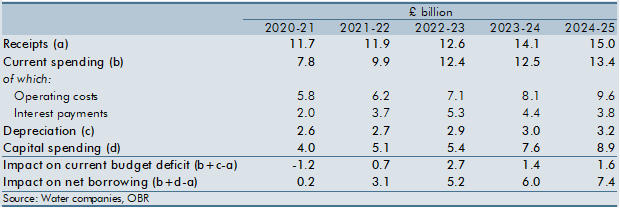
Reclassifying water companies into the public sector could have increased public sector net financial liabilities and borrowing, while having a relatively small impact on the current budget deficit. In this box, we explored how reclassification could have affected the public sector balance sheet, receipts and spending, and the Government’s fiscal targets.
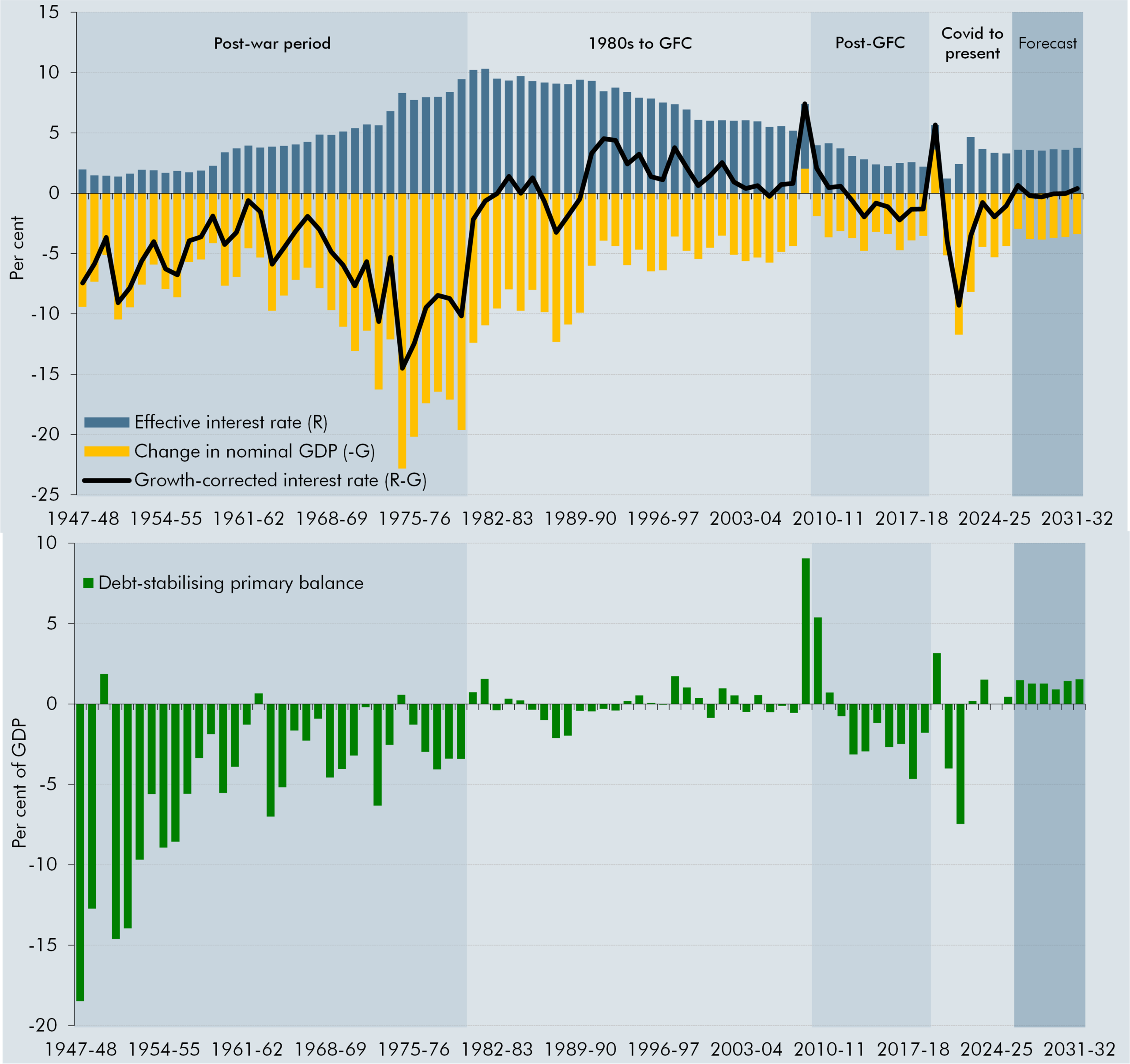
The growth corrected interest rate (R-G) is forecast to rise, increasing the debt stabilising primary balance. In this box, we explored the long-term trends of R-G and the implications for fiscal sustainability. R-G was negative during the post-war period, turned positive in the decades preceding the global financial crisis, and negative again when interest rates fell after the crisis. As the effective interest rate rises towards its historical average without being fully offset by nominal GDP growth, R-G turns positive by 2031-32. Combined with a much higher stock of debt, a primary surplus is required to stabilise debt.

Unfunded pension liabilities represent the second-largest government liability after gilts, but are not included in the PSNFL measure of debt. In this box, we analysed the treatment of unfunded pensions in the National Accounts and the fiscal risks they create.

The 2025 Spending Review increased the envelope for departmental financial transactions relative to the assumptions in our March 2025 forecast. In this box, we explored how this funding has been allocated and how this may impact future OBR work.
Broader measures of the balance sheet are useful to consider when thinking about fiscal sustainability. However, under the national accounts framework even the broadest measures fail to recognise natural assets – the very assets affected by climate change. The box discussed the frameworks under which the ONS produces the environmental and natural capital accounts, and which bodies are working to address the gaps in these frameworks. The box also discussed key messages from the Dasgupta Review and Treasury’s response.
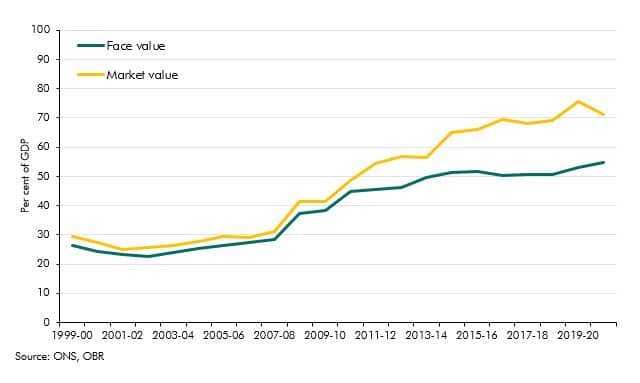
Government debt liabilities can be valued in various ways. In recent years market and face values have diverged sharply reaching 15% of GDP. In this box we explained why this has happened and why we use face value in our analysis.
When discussing the potential impact of fiscal risks on the public sector balance sheet in our 2017 Fiscal risks report, we focused on the Government’s target measure of public sector net debt and its broader, but less-well-known counterpart, public sector net financial liabilities. In this box we considered some of the pros and cons of three even broader measures of the public sector balance sheet.
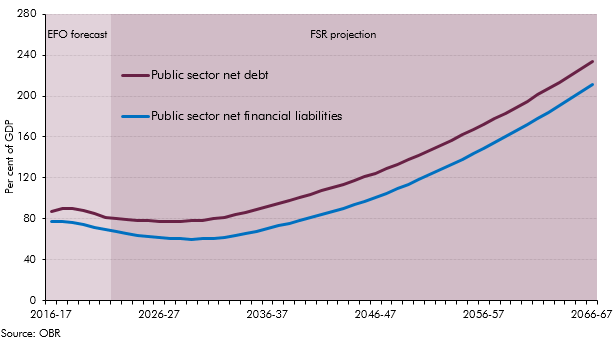
At Autumn Statement 2016 the Government asked us to forecast two new balance sheet metrics: PSND excluding the Bank of England and public sector net financial liabilities (PSNFL), a broader measure covering all the public sector’s financial assets and liabilities recorded in the National Accounts. This box presented our long-term projections for these two new balance sheet metrics with particular focus on PSNFL as PSND with and without the Bank of England tended to converge in our medium-term forecast and were expected to continue to do so over the long-term.
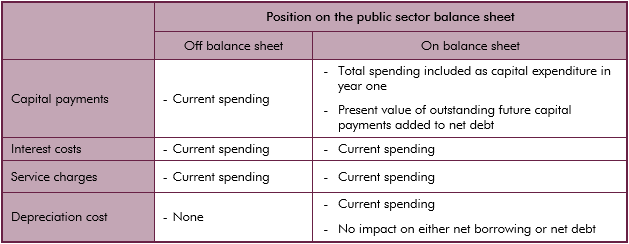
Depending on ONS classification assets relating to PFI contracts can be on the public sector or the private sector balance sheet. This box outlined the accounting of PFI contracts in the National Accounts and WGA.
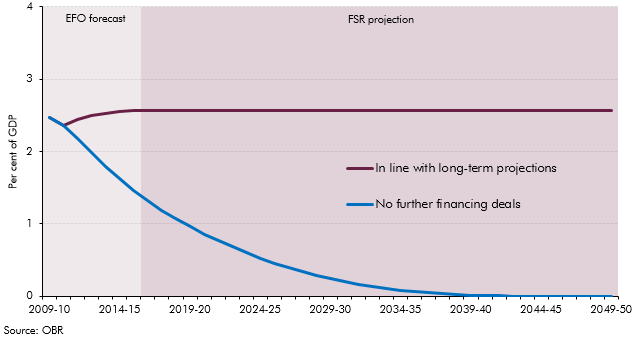
The majority of Private Finance Initiative (PFI) assets are held off the public sector balance sheet in the National Accounts. The running costs relating to existing PFI contracts are included within agreed departmental spending envelopes. This box explored the impact on our net debt projections if all capital liabilities relating to PFI contracts were included.