
Category Archive: What’s new

document or letter icon

Treasury Committee report concluding its inquiry into The OBR: 15 years on

The Treasury Committee has today published its report concluding its inquiry into The OBR: 15 years on. Responding to the report, Jonathan Haskel, Chair of the OBR’s Budget Responsibility Committee, said: “We welcome this report and thank Dame Meg Hillier and the Treasury Committee for their work. We appreciate the Treasury Committee’s support for the…

Combination line and bar chart showing cumulative public sector net borrowing

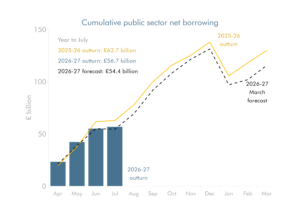
Year-to-date borrowing slightly above forecast profile

This morning’s ONS release estimates that borrowing in the first four months of 2026-27 totalled £56.7 billion. This is £6.0 billion below the same period last year but £2.3 billion above the monthly profile consistent with our March 2026 forecast. Central government receipts for the year-to-date are £2.8 billion above the forecast profile, primarily driven…

Photograph of Jonathan Haskel

Professor Jonathan Haskel confirmed as next Chair of the OBR

Professor Jonathan Haskel was nominated as the next Chair of the Office for Budget Responsibility by the Chancellor in June. The House of Commons Treasury Committee has now confirmed his appointment, saying ‘We are satisfied that Professor Haskel has the appropriate professional competence and personal independence to carry out his role‘. Find out more on…

Icon of three people

David Miles nominated for reappointment to the OBR’s Budget Responsibility Committee

The Chancellor of the Exchequer has today nominated Professor David Miles CBE for reappointment to the Office for Budget Responsibility’s Budget Responsibility Committee (BRC) for a second and final term, subject to the approval of the House of Commons Treasury Committee. As a member of the BRC, Professor David Miles shares executive responsibility for the…

document or letter icon

Response to the November 2025 Economic and fiscal outlook publication error

We have published a report setting out our response to the November 2025 Economic and fiscal outlook publication error and our progress against the recommendations of the resulting investigations. The report outlines our approach to web publishing, including interim arrangements using both GOV.UK and the OBR’s main website. It also explains the steps we have…

search icon

Non-executive member of the Office for Budget Responsibility

The Office for Budget Responsibility (OBR) was created in 2010 to provide independent and authoritative analysis of the UK’s public finances. We are seeking to appoint two non-executive members to the OBR’s Oversight Board, one to immediately replace Dame Susan Rice, whose first term ended on 19 June 2026, and one to replace Baroness Hogg…

Image of the Welfare trends report with text reading: 'Biennial report on welfare spending'

OBR’s 2026 Welfare trends report explores recent trends in welfare fraud and error

Welfare fraud and error rates rose sharply during the Covid pandemic in 2020-21 and 2021-22, a period which also coincided with the rollout of universal credit. Our new analysis shows that the increase was mainly driven by those making new welfare claims during the pandemic, and so was likely primarily due to temporary operational easements…

Baroness Sarah Hogg

Baroness Hogg re-appointed as a non-executive member of the OBR

The Chancellor of the Exchequer has announced that Baroness Hogg has been re-appointed as a non-executive member of the OBR. Tom Josephs and Professor David Miles said: “We are delighted that Baroness Hogg will be serving for a further year. We would like to record our immense gratitude for the invaluable contribution that Dame Susan…

bar chart in document icon

Supplementary forecast information release: Long-term economic determinants – March 2026

We have now published our latest long-term assumptions, consistent with the forecast in our March 2026 Economic and fiscal outlook (EFO), below and on the March 2026 EFO page. These economic determinants that underpin our long-term fiscal projections are used by organisations inside and outside government to inform their own long-term modelling.