
The Quarterly National Accounts published on 30 September by the ONS included revisions consistent with Blue Book 2025, which we have incorporated into our forecast. This box explored what these revisions were and their impact on our forecast. While the revisions to the starting level have not changed our view about the outlook for overall GDP growth, the compositional changes have contributed to our forecast judgements.
This box is based on ONS data from September 2025 .
The Blue Book is an annual ONS publication which updates the sources and methods used for the UK National Accounts. The Quarterly National Accounts consistent with the Blue Book 2025 were published on 30 September, and we incorporated the implications of this data for the starting level and composition of GDP into our forecast. The revisions indicate the economy is larger than previously thought, and that the business sector has accounted for a greater share of activity, while the household sector has accounted for a smaller share.
The Blue Book revisions raised the level of nominal GDP by 1.4 per cent in the second quarter of 2025 – the starting point of our forecast. Most of this revision is from before the pandemic, with the level of nominal GDP in 2019 up by 0.9 per cent (Chart C, left panel). The higher level therefore means little for current momentum in the economy and our forecast for GDP growth. Cumulative nominal GDP growth between 2019 and 2024 was revised up 0.4 percentage points, driven by upward revisions to growth between 2020 and 2022, partly offset by downward revisions in 2023 and 2024 (Chart C, right panel). Cumulative real GDP growth between 2019 and 2024 was revised up 0.5 percentage points, and cumulative growth in the GDP deflator was revised down 0.2 percentage points. Higher real GDP growth was driven by stronger investment and exports, partly offset by weaker consumption and higher imports.
Chart 2C: Nominal GDP revisions
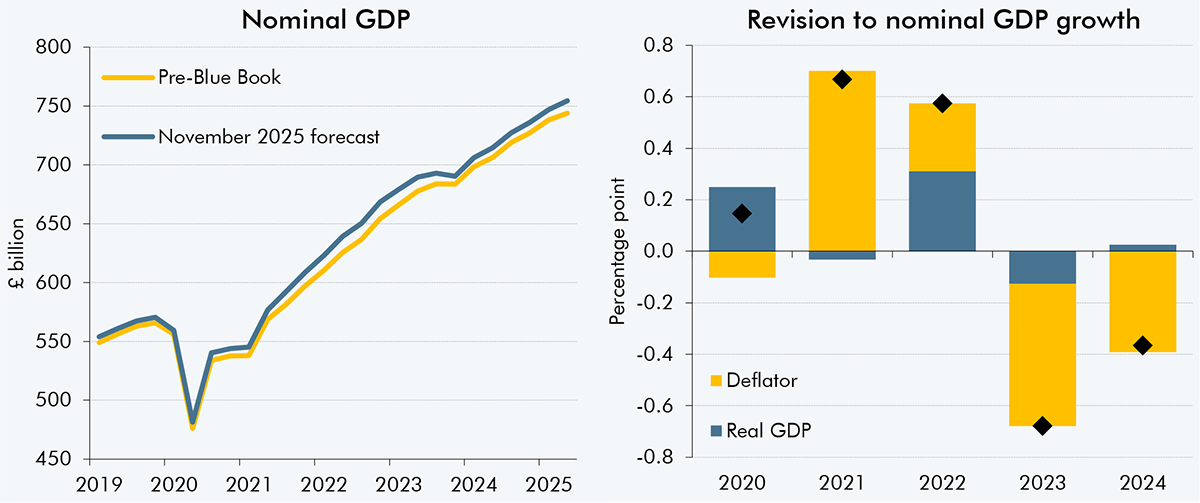
Note: Pre-Blue Book is consistent with the first quarterly estimate published by the ONS on 14 August 2025.
Source: ONS, OBR
The revisions also change the composition of GDP at the start of our forecast, with the economy driven less by household activity and more by business activity than previously thought (Chart D).
In the second quarter of 2025:
- On the income side, labour income as a share of GDP was revised down 1.3 percentage points, from 48.1 to 46.9 per cent. Meanwhile, the share of corporate profits was revised up 0.9 percentage points, from 14.9 to 15.9 per cent. The share of other income in nominal GDP (including employer social contributions, imputed rents and government depreciation) was revised up 0.4 percentage points.
- On the expenditure side, household consumption as a share of GDP was revised down 1.2 percentage points, from 61.9 to 60.7 per cent. Business investment’s share of GDP was revised up 1.6 percentage points, from 8.5 to 10 per cent. The share of other expenditure in nominal GDP (including government spending, inventories and net exports) was revised down 0.3 percentage points.
Chart 2D: Revisions to nominal GDP composition in the second quarter of 2025
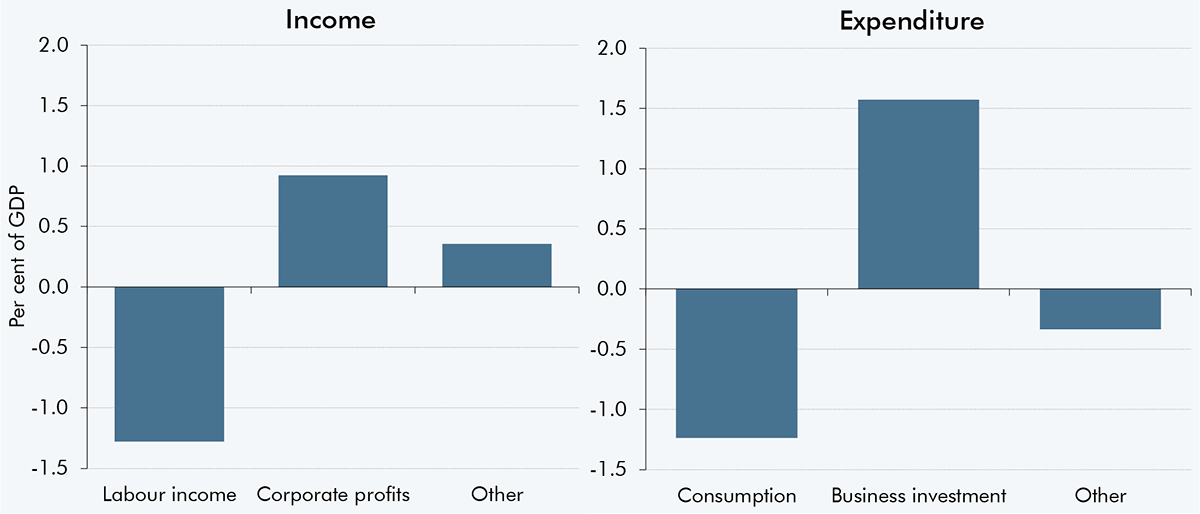
Note: Other income includes employer social contributions, North Sea and financial company profits, corporate rent income, factor cost adjustments, other operating surplus, and a statistical discrepancy. Other expenditure includes government spending, residential investment, net trade, changes in inventories and valuables, and a statistical discrepancy.
Source: ONS, OBR
While the revisions to the starting level have not changed our view about the outlook for overall GDP growth, the compositional changes have contributed to our forecast judgements. We now expect a stronger recovery in the consumption share of GDP, and a shallower decline in the labour share of income over the forecast, partly due to both starting from a lower point. Conversely, we expect weaker profits growth, as the revisions imply firms have less need to rebuild margins than previously thought (see paragraph 2.47). These judgements have affected the outlook for tax bases, which affects the fiscal outlook (see paragraph 2.64).
This box was originally published in Economic and fiscal outlook – November 2025