
Recent merger activity has enabled companies with a large stock of historical tax losses to combine operations with profitable tax-paying companies, allowing greater use of losses against taxable profits. In this box, we explored how mergers affected the use of tax losses and the impact on the oil and gas receipts forecast.
This box is based on HMRC, NSTA, and ONS data from August 2026 .
Recent merger activity by firms operating in the UK continental shelf has resulted in companies with a large stock of tax losses combining operations with tax-paying companies, allowing greater use of losses against taxable profits. The 2021 to 2023 period saw expansion of larger and mid-sized oil and gas companies, outside of the major international groups. Since 2024, several of these companies have merged with portfolios held by major international companies.
The impact of this activity was a key factor behind the downward revision to our November 2025 forecast for offshore corporation taxa and in this forecast has muted the upward impact on receipts this year of higher oil and gas prices. Our tax forecasts are generated by HMRC’s North Sea microsimulation model, which captures M&A activity by combining information on company ownership of fields and tax returns data. The mergers in 2025 and 2026 had a similar pattern of dampening the receipts forecasts in both this and the November 2025 forecast, largely through making the stock of historical losses more readily accessible to profitable companies.
The left panel of Chart A shows the impact on losses used of the mergers incorporated at this forecast. The blue bars show the change in losses used due to recently completed mergers, which increase by a net £2.7 billion between 2026 and 2031. The frontloaded pattern reflects the assumption that, once historical losses become accessible, they are used as quickly as possible. Higher oil and gas prices in the early part of the forecast also generate more profits against which the losses can be used. This frontloading of loss utilisation results in a faster rundown of the stock of outstanding losses, leaving fewer losses available for use in the later years of the forecast.
The forecast also includes an assumption that a further 20 per cent of the stock of losses become accessible from possible future mergers.b The impact of this, shown by the yellow bars, is to increase losses used by £2.2 billion between 2026 and 2031.
The right panel shows the impact on receipts from the greater losses used, which mirrors this pattern, with greater reductions in the early years of the forecast when more losses are available against taxable profits. The net impact between 2026-27 and 2031-32 is a reduction of £1.3 billion from completed mergers and £0.8 billion from the adjustment for future mergers.
Chart A: Impact of M&A activity on losses used and oil and gas receipts
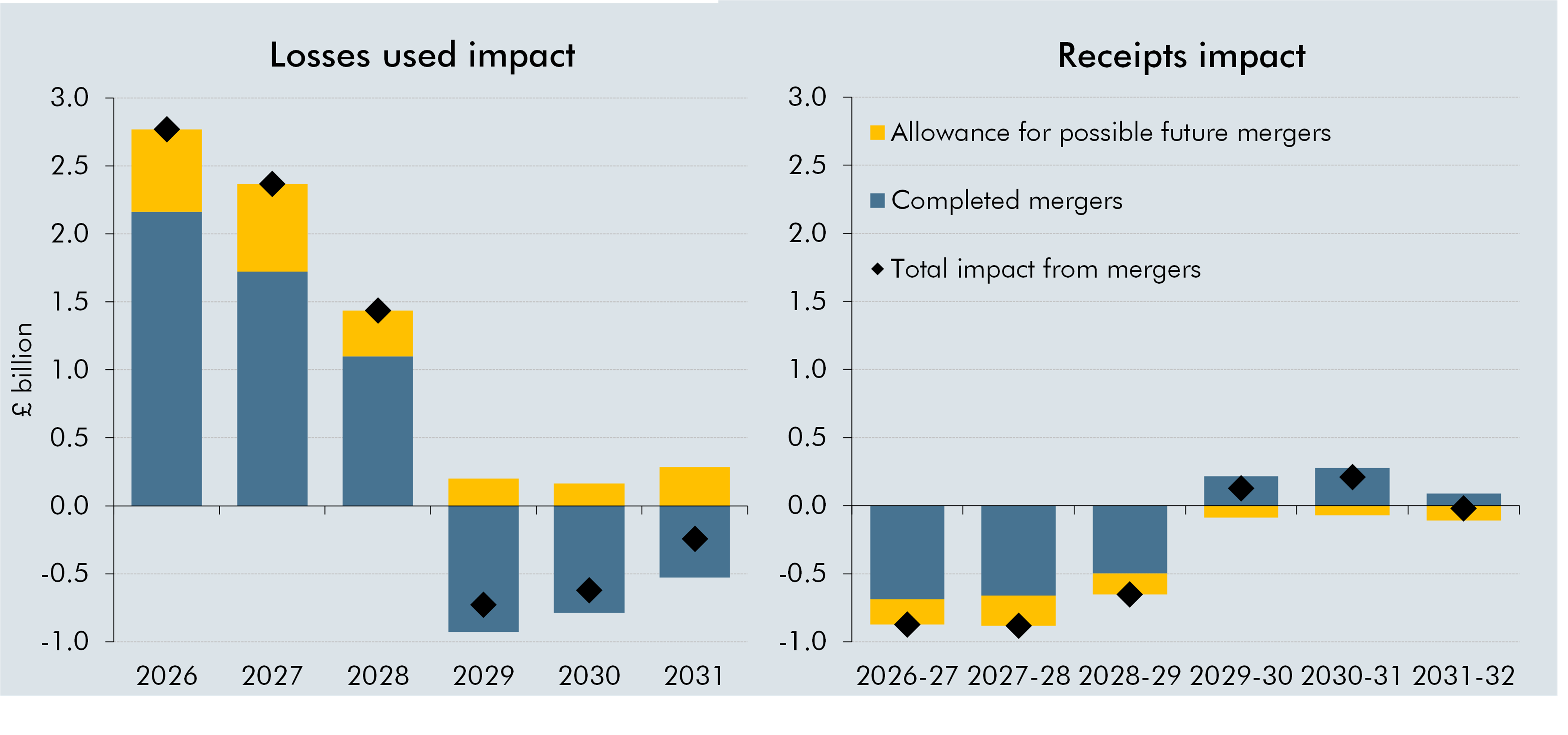
Note: The charts reflect impacts to ring fence corporation tax and the supplementary charge.
Source: HMRC, NSTA, ONS, OBR
This box was originally published in Economic and fiscal outlook – October 2026