
The UK Budget saw the extension of the personal tax threshold freezes. This box looked at the projected impact of the threshold freezes on the net tax position in Scotland and Wales.
This box is based on OBR data from November 2025 .
The UK Budget sees the extension of the personal allowance (PA), higher rate and additional rate threshold freezes until 2030-31. Most personal tax thresholds have been frozen in cash terms since April 2021. The resulting ‘fiscal drag’ raises significant revenue, especially when inflation and nominal earnings growth is strong, as more workers find that their earnings enter the tax system or are taxed at higher rates. Across the whole of the UK, these freezes are expected to yield £66.6 billion by the end of the forecast compared with if thresholds have been indexed to CPI.a However, the freezes have different impacts tor the budget positions of Wales and Scotland.b
Scotland
In Scotland, the PA is reserved to the UK Government but the Scottish Parliament has the power to change other rates and thresholds and create new bands. As shown in Table 5.A, currently there are 6 bands – the starter, basic, intermediate, higher, advanced and top rate – which creates a more progressive structure of taxation compared to the rest of the UK. In Scotland, the higher rate limit has been frozen since 2021-22 while other limits have been uprated by CPI.c The Scottish government also introduced a new advanced rate threshold which took effect from 2024-25.
Our forecast incorporates recent Scottish Government policy to freeze the higher, advanced and top-rate thresholds in 2026-27. But, in the absence of stated Scottish government policy, our baseline assumption, in line with the SFC, is that all other bands are indexed by CPI for 2026-27 and that all bands are indexed by CPI from 2027-28 onwards. As a result, the freeze to the higher rate and additional rate announced by the UK Government (excluding the PA taper) do not directly impact Scottish income tax receipts. This means differences in growth rates between ENI receipts and Scottish income tax will partly reflect these policy differences.
Table A: Personal income tax thresholds and rates in Scotland and the rest of UK
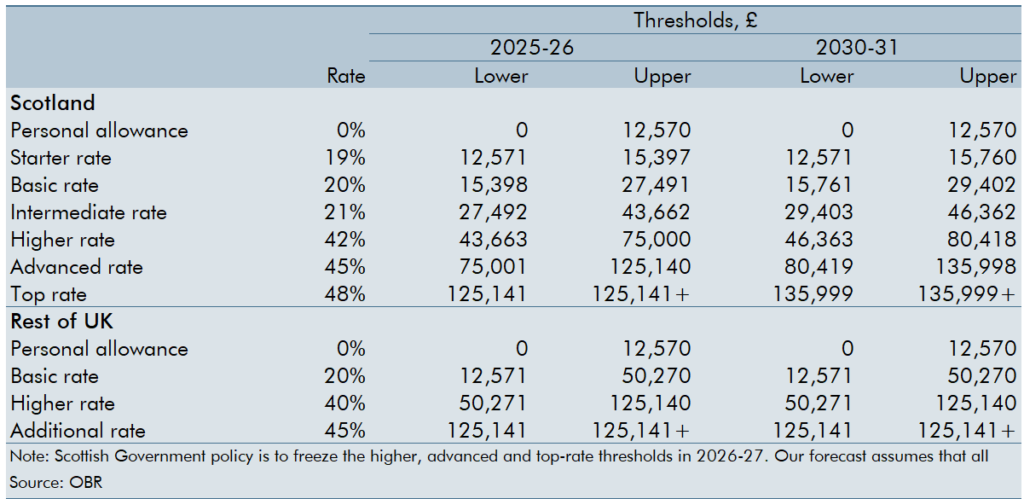
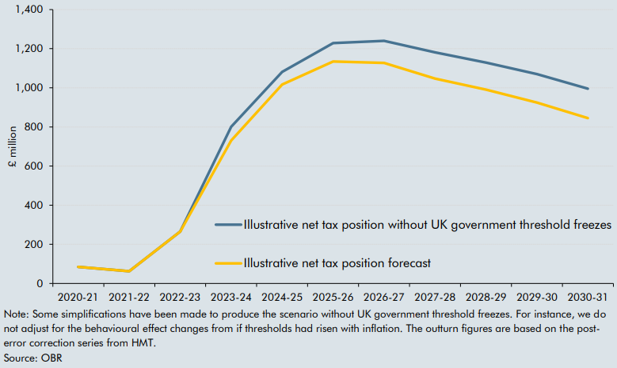
Chart A shows the illustrative net tax position for Scotland based on the latest OBR forecast, and in a counterfactual scenario assuming the UK Government thresholds had risen in line with CPI. It shows that:
- In the near-term, the net tax position increases in both our forecast and the counterfactual scenario, rising to £1.1 billion in the forecast in 2026-27 and £1.2 billion in the counterfactual scenario. The rise in both cases is due to the freezes in Scottish income tax thresholds, especially the higher rate, which increase Scottish tax receipts more than in England and Northern Ireland (ENI) due to Scotland’s more progressive tax system. The faster growth in the counterfactual scenario reflects the fact that ENI receipts, which form the basis of the block-grant adjustment, grow more slowly in the scenario where thresholds are uprated with CPI.
- From 2027-28 onwards, the gap between the net tax position in the two scenarios widens, with the illustrative net tax position £0.2 billion lower by the end of the forecast period compared with if UK government thresholds are frozen. This is due to the baseline forecast
assumption that in Scotland limits are uprated with CPI, compared to the policy in England and Northern Ireland of frozen thresholds. The overall decline in both forecasts reflects demographic change in Scotland related to population ageing, which lowers the growth rate of income tax receipts for Scotland more than in England and Northern Ireland in our forecast.
Chart A: Impact of threshold freezes on Scottish income tax net position
Wales
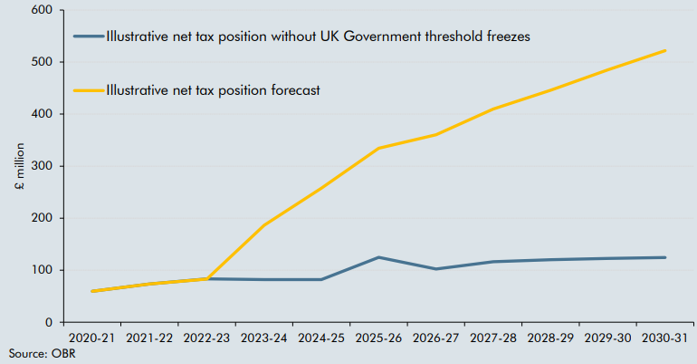
In Wales, the Welsh Government only has the power to change Welsh income tax rates which apply to the first 10p in the pound of each tax band set by the UK government but not the income tax thresholds. Therefore, income tax thresholds in Wales are aligned with those in England and Northern Ireland, and the UK Government threshold freezes also apply to Welsh taxpayers. Chart B shows the latest forecast for the net income tax position and an illustrative scenario showing the net income tax position assuming UK thresholds are indexed in line with CPI. It shows that the illustrative net income tax position in Wales is £0.4 billion higher by the
end of the forecast because of the combined effect of threshold freezes since 2022-23. This is due to:
- Income distribution in Wales: Threshold freezes have a greater impact in Wales because a higher percentage of individuals than in England and Northern Ireland are at the lower end of the income distribution. For example, in 2024-25, we estimate that 88.5 per cent of Welsh taxpayers have incomes below the higher rate threshold, compared with 82.4 per cent in England and Northern Ireland.d This means that fiscal drag is stronger in Wales as a larger proportion of Welsh taxpayers are pushed into the basic, higher, and additional rate bands than in England and Northern Ireland, where there is already a comparatively higher share. We forecast that Welsh rate income tax receipts will be 21.3 per cent higher as a result of frozen income tax thresholds by 2030-31 compared with 14.3 per cent for the “equivalent” England and Northern Ireland.e
- Structure of Welsh Income tax rates: the design of Welsh rates of income tax and block grant adjustment mean unlike Scotland, it is not only overall relative growth rates which drive differences in the net income tax position but also the relative growth rates of the different income tax bands. In particular, given that Welsh rates apply to the first 10p of each tax band, the basic rate has skewed importance explaining the majority (55 per cent) of the difference in the net income tax position between the forecast and the counterfactual
scenario. This is despite the freeze having a larger impact on the growth in higher and additional rate receipts in Wales compared to the “equivalent” England and Northern Ireland bands.
Chart B: Impact of threshold freezes on Welsh rate of income tax net tax position
This box was originally published in November 2025 Devolved tax and spending forecasts