
The composition of gilts issued by the Debt Management Office in recent years has become more skewed toward shorter maturities. In this box, we explored the implications of a lower average maturity of UK marketable debt.
This box is based on DMO and OBR data from November 2025 .
Public sector net debt has risen from 28 per cent of GDP in 2000-01 to 94 per cent of GDP at the end of 2024-25. The UK government meets most of its financing needs through the issuance of gilts across varying maturities, and so the stock of outstanding gilts has risen over the same period from 24 per cent of GDP to 83 per cent of GDP. With a high stock of debt, there are significant volumes of redemptions each year as existing gilts mature and require refinancing at the prevailing market interest rate.
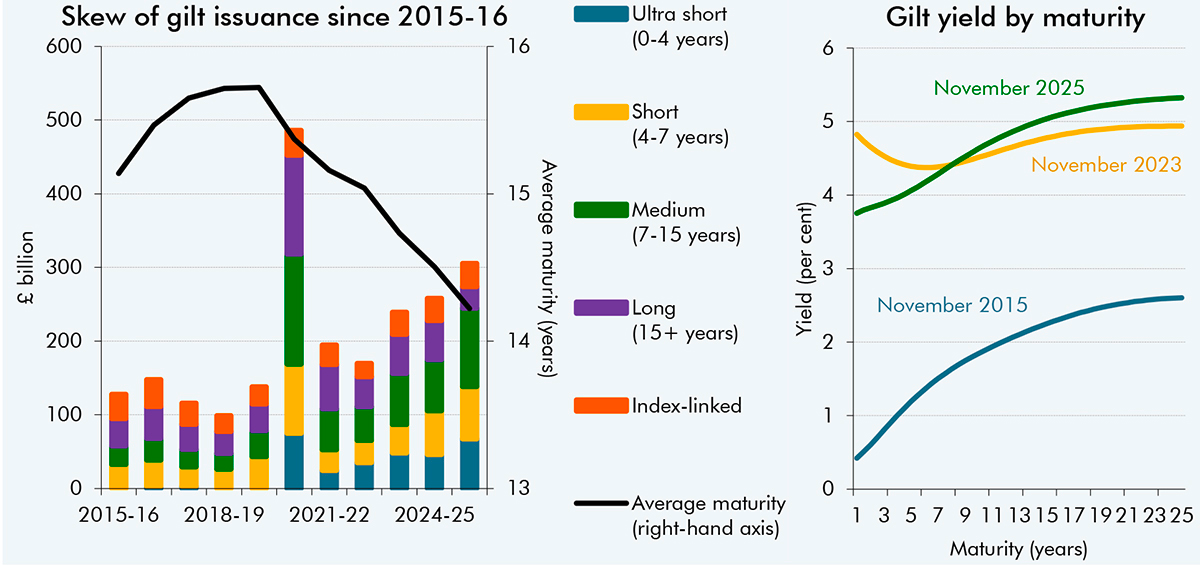
The composition of gilts issued by the Debt Management Office (DMO) in recent years has become more skewed toward shorter maturities. Ultra-short and short maturity buckets (gilts with a maturity of less than seven years) are planned to make up 44 per cent of new issuance this financial year, nearly a 20 percentage point increase compared to 2015-16. Issuance of long maturity bonds (gilts with a maturity of 15 years or longer) has decreased by 20 percentage points over the same period. As a result, so far this year, gilt issuance has an average maturity of 10 years, which is around half the average maturity of 20 years of the gilts issued a decade ago in 2015-16. This shift in the Government’s issuance strategy to favour shorter-dated gilts reflects shifts in market demand toward shorter maturities as defined benefit pension schemes reduce their demand for longer-dated gilts, which we analysed in detail in the 2025 Fiscal risks and sustainability report.
Despite this, the average maturity of outstanding UK marketable debt, at 14 years, continues to be the highest in the G7 where average debt maturities average seven years and range from six years in United States to nine years in Japan among other G7 countries, even after adjusting for the impacts of Quantitative Easing (which reduce the UK average to around 11 years). And, as the Bank unwinds its remaining holdings of longer-dated gilts, the average maturity of the debt stock will lengthen.a
This increase in DMO gilt issuance at shorter maturities has had several implications:
- In the short term, it reduces debt interest spending as gilt yields are currently lower at the shorter end of the yield curve. Relative to the time of the March 2025 forecast, five-year gilt yields have decreased by 7 basis points compared to an increase of 33 basis points for 30-year gilt yields. If the DMO’s planned split of gilt maturities had remained the same as Autumn 2015, and at unchanged gilt yields, debt interest costs would have been approximately £2.4 billion higher by 2029-30. Whether movements in yields in the face of a different issuance strategy would have offset this is unclear.
- Over the medium term, it increases re-financing risk as more debt needs refinancing each year exposing the government to short-term fluctuations in prevailing market rates. A 1 percentage point shock to interest rates from 2025-26 would lead to a £17 billion increase in debt interest spending in 2030-31. The current stock of conventional gilts this financial year has an effective interest rate of 2.9 per cent. Based on current yields, which are reflected in our central forecast, these redemptions would be re-financed at an average expected yield of 4.4 per cent.
A shorter average maturity of debt, and the consequent increase in short- and medium-term refinancing volumes, increases the risk that further fiscal adjustment may be required to maintain debt sustainability, were interest rates to rise by more than expected in future. A rise in interest rates compared to expectations will increase both the cost of new borrowing for the Government and the cost of refinancing existing debt. Market pricing suggests that the weighted average gilt rate in 2030-31 will be 1 percentage point higher than in 2025-26, so debt redeeming at that point would need to be refinanced at a higher interest rate.
With higher overall debt interest costs, a government needs to run a higher primary balance (the difference between revenue and non-interest expenditure) in order to stabilise debt. Over the past decade, growth rates of nominal GDP have mostly exceeded effective interest rates which meant a sustained primary deficit (a negative primary balance) could still lead to a stable debt position. However, this is forecast to change mainly due to the sharp rise in interest rates from 2022 increasing the effective interest rate that the government pays on its debt. In our latest forecast, a primary balance surplus is necessary from 2028-29 onwards in order to stabilise the debt-to-GDP ratio.
Chart 6A: Skew of gilt issuance since 2015-16 and gilt yields by maturity
Source: DMO, OBR
This box was originally published in Economic and fiscal outlook – November 2025