
Local authorities continue to face significant cost pressures providing for special educational needs and disabilities. In this box, we explored the scale of this cost pressure, how we expect it to evolve over time, and the fiscal implications to local and central government.
This box is based on DfE, HMT, and OBR data from November 2025 .
Local authorities receive a ring-fenced grant from the Department for Education (DfE) to pay for mainstream and special needs education for children and young people – the dedicated schools grant or DSG. The 2014 Children and Families Act expanded the statutory obligations of local authorities towards children and young people with special educational needs and disabilities (SEND). Under the Act, local authorities were given a statutory obligation to assess whether children and young people have a special educational need or disability; require an education, health and care plan (EHCP) to address that need or disability; secure educational provision according to these plans; and provide recipients of EHCPs with suitable education placements in either a mainstream or special education school.
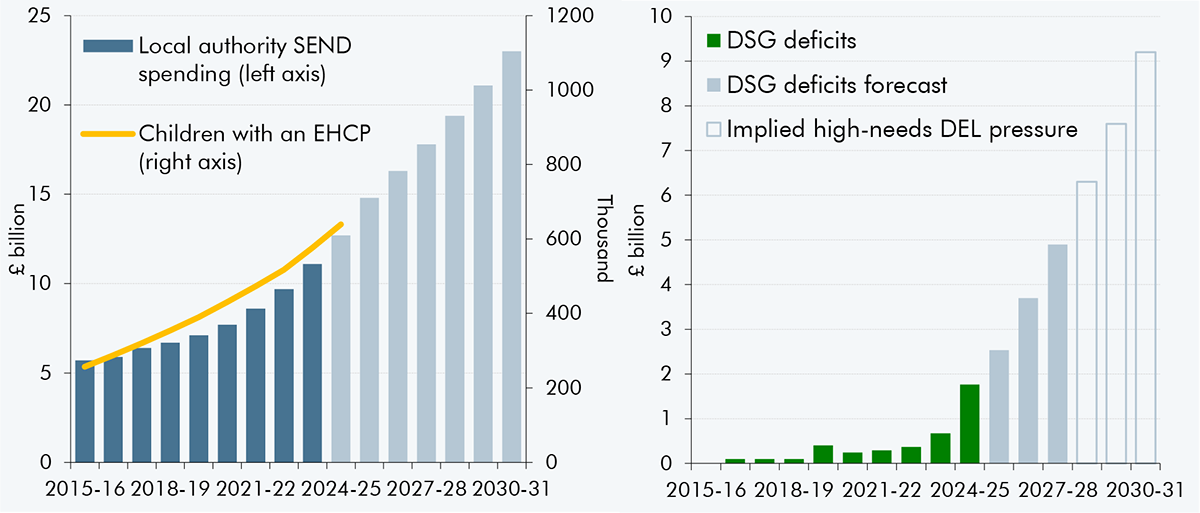
Between 2016 and 2025, the number of children and young people with an EHCP has more than doubled from 256,000 to 639,000, and risen from under 3 per cent to over 5 per cent of all pupils.a This has significantly increased cost pressures on local authorities, with the result that the DSG has been insufficient to cover SEND spending since 2020. In 2020, the Government introduced a temporary ‘statutory override’ allowing local authorities to ignore SEND spending above the DSG grant (the DSG deficit) for the purpose of recording a balanced budget. The override was initially set to expire in April 2023 but was then extended in January 2023 to April 2026. These DSG deficits have steadily increased from £0.2 billion in 2020-21 to an estimated £2.5 billion in 2025-26 (Chart A)
he statutory override has masked, but not resolved, the pressures on local authority finances from SEND spending. While the override makes it easier for local authorities to meet their legal requirement to run a balanced budget, they must still finance costs that exceed the grant through additional borrowing, the use of un-ring-fenced reserves, or a reduction in spending on other non-statutory services. Partly because of SEND pressures, local authorities’ liquid assets have fallen from £35 billion in 2020-21 to £22 billion in 2024-25. The stock of local authority debt via the Public Works Loan Board and other mechanisms has also increased from £120 billion in 2021-22 to £136 billion in 2024-25. In October 2024, the National Audit Office (NAO) estimated that, without the statutory override, 43 per cent of local authorities would be at risk of issuing a Section 114 report, indicating that the local authority is unable to balance its budget.b
In June 2025, the Government extended the statutory override by a further two years to April 2028. DSG deficits are now forecast to rise further in these two years and reach £4.9 billion in 2027-28 (Chart A), with the cumulative DSG deficits accumulated by LAs forecast to reach £14 billion by the end of the new override period, equivalent to around two-thirds of the total liquid assets local authorities held in 2024-25.
Chart A: The increasing costs of special educational needs provision
Note: DSG deficit outturn data from 2015-16 to 2019-20 is sourced from section 251 LA budget returns. Data up to 2025-26 is sourced from revenue outturn (RO) data submitted by LAs.
Source: DfE, OBR
The Government has announced at this Budget that all SEND spending from 2028-29 will be absorbed within existing RDEL limits, though it has not specified how this will be achieved. Chart A shows that, based on current SEND policy, this pressure is forecast to reach £9 billion by 2030-31.c We discuss the implications of absorbing this significant pressure into central government DEL in paragraph 5.20 above. The Government has stated that it will publish a white paper early in the new year setting out reforms to the SEND system.
This would mean that LAs would not build up further DSG deficits from 2028-29. However, based on current policy, LAs would then be required to recognise the historic DSG deficits, which are expected to reach £14 billion, on their balance sheets. This would be very likely to result in many local authorities issuing Section 114s, due to being unable to set a balanced budget. The fiscal impact of this would depend on how central government and individual LAs respond. The Government has not set out how it will address this issue other than to state that its policy position is to work with local authorities to manage their SEND deficits and that it will set out more detail at the provisional Local Government Finance Settlement in December 2025.
This box was originally published in Economic and fiscal outlook – November 2025