
The UK Government's freezes to personal tax thresholds are expected to have a positive effect on the Welsh Government's budget. This box explored the reasons why.
This box is based on HM Treasury and OBR data from January 2026 .
The Autumn 2025 Budget saw the extension of the personal allowance (PA), higher rate and additional rate threshold freezes until 2030-31. Most personal tax thresholds have been frozen in cash terms since April 2021. The resulting ‘fiscal drag’ raises significant revenue, especially when inflation and nominal earnings growth is strong, as more workers find that their earnings enter the tax system or are taxed at higher rates. Across the whole of the UK, in our November 2025 EFO, we estimated that the threshold freezes would yield £66.6 billion by the end of the forecast compared with the previous UK Government policy of thresholds rising with inflation.
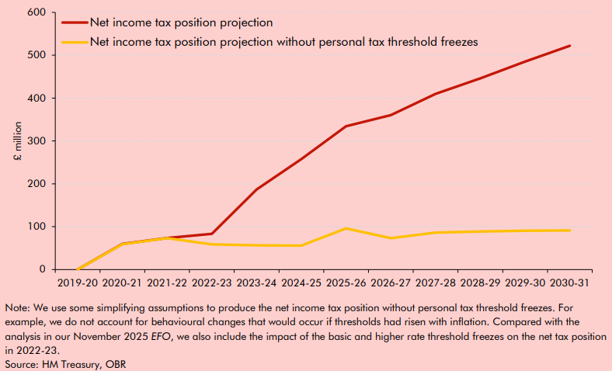
For the Welsh budget, the direct impact of these changes is captured by the impact on the net income tax position, that is, the extent to which Welsh rate receipts rise faster than the tax BGA (which is based on the change in England and Northern Ireland receipts) as a result of the freezes. Chart A shows the net income tax position based on our latest forecasts, and a
counterfactual assuming thresholds had risen in line with inflation. It shows that:
- Between 2019-20, the year of devolution of Welsh rates, and 2023-24, the latest outturn year for income tax, the net income tax position rose to £187 million. We estimate that in the absence of the personal allowance and higher rate threshold freezes and the lowering of the additional rate threshold from 2022-23 onwards, the net income tax position would have risen more modestly to £57 million.
• From 2023-24 onwards, we expect the net income tax position to rise from £187 million to £522 million by 2030-31, £431 million higher than in the scenario without the threshold freezes. This means that cumulatively, we estimate the combined effect of the threshold freezes since April 2021 to have improved the Welsh budgetary position by £2.4 billion by 2030-31.
Chart A: Impact of threshold freezes on the Welsh net income tax position
Given that thresholds and rates are aligned between Wales and England and Northern Ireland, this improvement in the net tax position reflects distributional differences in income. In Wales, there is a higher proportion of individuals at the lower end of the income distribution. In 2024
25, we estimate that 88.5 per cent of Welsh taxpayers have incomes, on an NSND basis, below the higher rate threshold, compared with 82.4 per cent in England and Northern Ireland. This means that, when thresholds are fixed and incomes rise, a greater number of taxpayers are pushed above the threshold compared to England and Northern Ireland, where there is already a comparatively higher share. As a result, Welsh rates receipts grow faster than England and Northern Ireland receipts and the corresponding tax BGA.
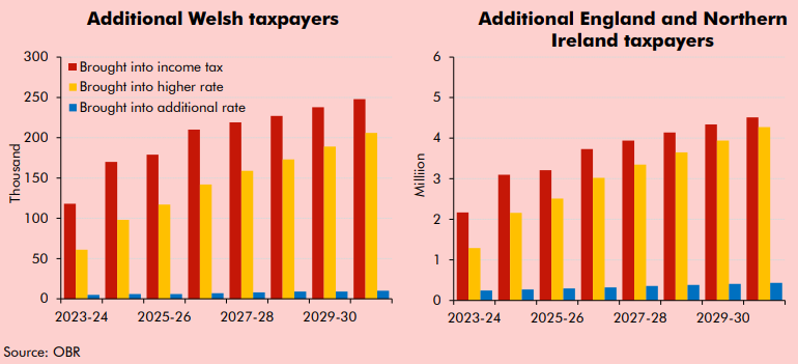
Chart B shows that, in our central forecast, we expect there to be an additional 248, 206 and 10 thousand basic, higher and additional rate Welsh taxpayers by 2030-31 as a result of the freezes. This compares to 4.5, 4.3 and 0.4 million, respectively, for England and Northern Ireland taxpayers. While the absolute increases in Wales are smaller than in England and Northern Ireland, the percentage change in the number of taxpayers is greater in Wales. For example, in 2030-31, we expect there to be 15, 186 and 67 per cent more basic, higher and additional rate Welsh taxpayers compared to if thresholds had risen with inflation. This compares
to 13, 117, 48 per cent more in England and Northern Ireland.
Chart B: Number of taxpayers brought into tax bands by threshold freezes
This box was originally published in Welsh taxes outlook – January 2026