
Scottish income tax and Welsh rates of income tax receipts in 2023-24 were higher than forecast. In this box, we assessed the reasons for these forecast differences.
This box is based on HMRC and OBR data from March 2026 .
HMRC published 2023-24 outturn data for Scottish income tax and Welsh rates of income tax in July 2025, which enables us to assess the performance of our forecasts for that year. This is important for transparency and accountability, while also helping us to understand and identify ways to improve our forecasts. In this box, we evaluate our March 2023 forecasts for Scottish and Welsh rates receipts in 2023-24 compared to eventual outturn.
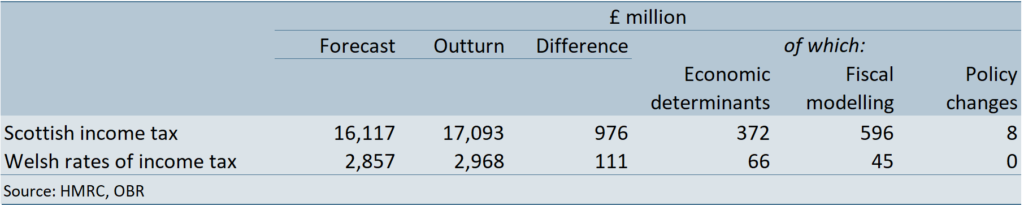
Our March 2023 forecasts were produced against the backdrop of high inflation and rises in interest rates. The forecast drew on the UK-wide economic projections set out in the March 2023 EFO, the 2019-20 Survey of Personal Incomes, UK-wide PAYE outturn data from 2020-21, and RTI data from December 2022. Table A shows our forecasts compared with the eventual outturn. It shows that:
- Scottish income tax receipts were £976 million (6 per cent) higher than forecast. Economic determinants account for £372 million of this difference reflecting stronger UK wide growth in wages and salaries, which grew by 6.4 per cent compared to our forecast of 4.0 per cent. The majority of the error, however, is explained by fiscal modelling
differences (£596 million). Around three-quarters of the fiscal modelling error is explained by our underestimate of the Scottish share of UK NSND receipts. Scotland has a more progressive structure of taxation, which makes the Scottish share sensitive to changes in nominal earnings. Part of the explanation for the underestimate of the
Scottish share is therefore likely to reflect our underestimate of nominal earnings growth, as the effective tax rate on incomes rose faster in Scotland as more Scottish taxpayers moved into higher tax bands compared with the rest of the UK. Policy announcements
since our forecast explain only a small proportion of the difference (£8 million). - Welsh rates of income tax receipts were £111 million (4 per cent) higher than forecast. Economic determinants explain £66 million of this difference, again reflecting higher than-expected UK-wide growth in wages and salaries. Fiscal modelling explains most of the remainder (£45 million), with around half of this explained by a higher-than-expected Welsh rates share of UK NSND receipts. The difference relating to subsequently announced policies is small (£0.3 million).
Table A: Scottish income tax and Welsh rates of income tax in 2023-24: March 2023 forecast versus outturn
This box was originally published in March 2026 Devolved tax and spending forecasts