
This Budget has extended the allowances and threshold freezes in income tax and National Insurance Contributions (NICs) to the end of the forecast period. In this box we explored the overall impact of threshold freezes since 2022-23 on additional taxpayers and tax receipts.
This box is based on OBR data from November 2025 .
This Budget has extended the allowances and threshold freezes in income tax and National Insurance contributions (NICs) to the end of the forecast period. This means the majority will have been frozen for most of the 2020s. Freezing thresholds, rather than raising them in line with inflation, increases tax receipts as rising wages tip ever greater numbers of workers into the tax system or onto higher rates, which is known as ‘fiscal drag’.
After an initial freeze covering two years from April 2019 and then an increase with CPI inflation in 2021-22, the income tax personal allowance (PA) and the higher-rate threshold (HRT) were frozen at £12,570 and £50,270, respectively, from 2022-23 to 2025-26.a These freezes were extended for a further two years to 2027-28 in November 2022, and this Budget has extended them to 2030-31. Had the PA and HRT instead moved in line with inflation, they would be forecast to be £4,900 and £20,100 higher, respectively, by 2030-31.
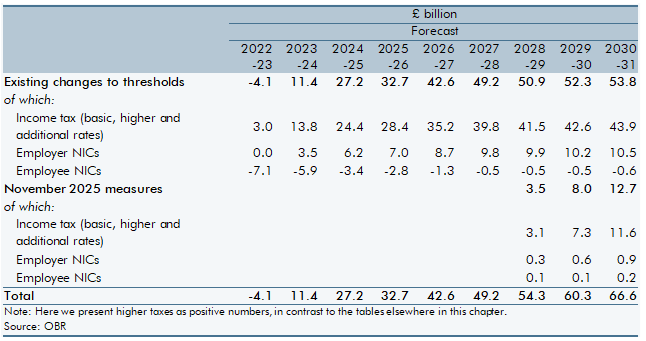
In November 2022, the additional-rate threshold (ART) was lowered from £150,000 to £125,140 from April 2023 to align with the PA taper. This was the first change to the ART since it was introduced at £150,000 in April 2010 and it will remain frozen until 2030-31. Overall, the changes to income tax covering the freezes at the basic, higher and additional rates are forecast to yield a total of £56 billion in 2030-31, of which £12 billion is from the freezes announced at
this Budget (Table A).
The secondary threshold freeze for employer NICs has been extended for an additional three years until 2030-31 at this Budget, after initially being frozen from 2023-24 to 2027-28 in November 2022. This threshold was also reduced from £9,100 to £5,000 in the changes to employer NICs announced at Autumn Budget 2024. Overall, the freeze to the employer NICs secondary threshold is forecast to yield around £11 billion in 2030-31, of which £0.9 billion is from the freezes announced at this Budget.
In March 2022, the primary threshold and lower profits limit for employee NICs were increased to align with the PA (with an equivalent rise in Class 2 NICs) and then frozen until 2025-26, a freeze which was extended in November 2022 to 2027-28. Although the freeze to the primary threshold has offset some of the negative yield from the initial alignment with the PA, the overall yield is still negative at £0.4 billion by 2030-31.
By the end of the forecast period, Table A shows that the overall impact of the freezing of all allowances and thresholds on receipts is estimated to be £67 billion (1.8 per cent of GDP), of which the freezes announced at this Budget contribute £13 billion in 2030-31. The estimated cost in 2027-28, when the previous set of freezes were set to end, is £3.3 billion higher than in our March 2025 forecast, as a result of higher nominal earnings in this forecast. Frozen thresholds are the largest contributor to the overall increase in the tax take this decade – responsible for almost three-fifths of the 3.1 per cent of GDP increase in taxes from 2022-23 to 2030-31.
Table 3A: Latest yield of tax threshold measures
The previously announced freezes and the extensions at this Budget are now expected to mean that between 2022-23 and 2030-31, 5.2 million additional individuals will have been brought into paying income tax, 4.8 million more will have moved to the higher rate, and 600,000 more onto the additional rate (Chart B). Compared to our March forecast, where freezes were due to end from April 2028, we estimate that these numbers are 780,000, 920,000, and 4,000 higher, respectively, in 2029-30, largely as a result of the extensions announced in the Budget.b Overall, the freezes have led to the forecast proportion of taxpayers being at either the higher or additional rate increasing from 15 per cent in 2021-22 to 24 per cent in 2030-31.
Chart 3B: Effect of threshold freezes on additional taxpayers and tax receipts
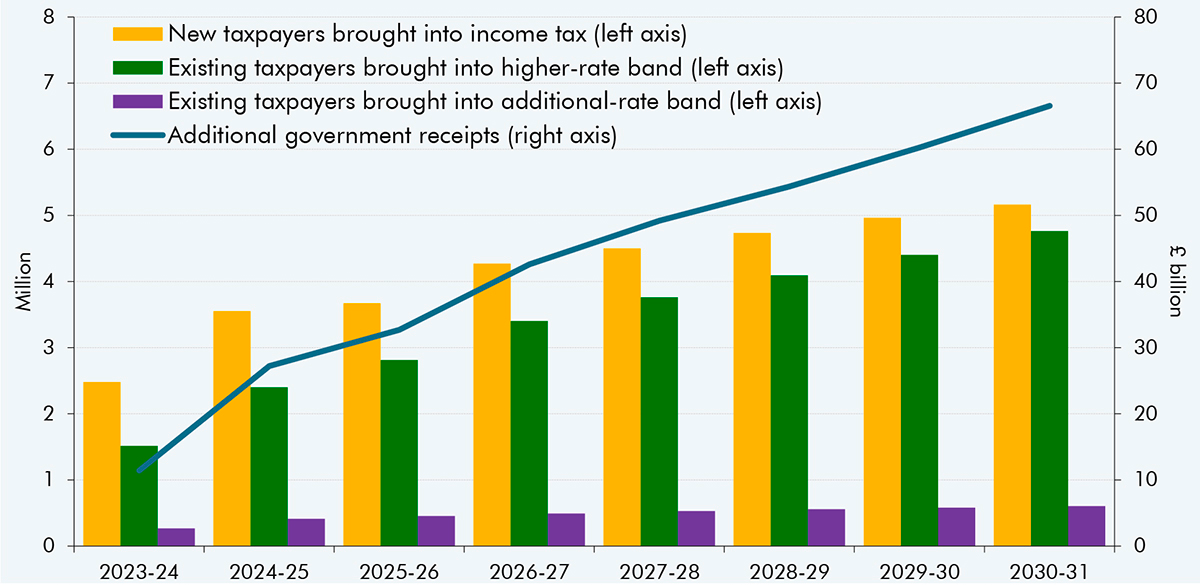
Note: The additional government receipts are the total value of all income tax and NICs measures outlined in Table A.
Source: OBR
This box was originally published in Economic and fiscal outlook – November 2025