
Environmental levies on household energy bills have been increasing reflecting a shift away from the taxation of energy extraction to taxation on the consumption of energy. In this box, we considered some of these schemes and how they have been impacted by Government policy at this event.
This box is based on OBR data from November 2025 .
In our latest forecast, we expect revenues from North Sea taxes (offshore corporation tax, including ring fence corporation tax and the supplementary charge, petroleum revenue tax, and the energy profits levy) to fall from £2.7 billion in 2025-26 to £0.3 billion in 2030-31. This continues the gradual decline in North Sea revenues over several decades due to falling production levels, which has only been interrupted by periods, such as in 2022, when oil and gas prices have spiked (Chart C). Box 4.3 in the March 2023 Economic and fiscal outlook has further detail on the decline in North Sea receipts between 1975 and 2022.
While oil and gas revenues have been on a downward trend since the early 2000s, receipts from environmental levies on household energy bills have risen from £0.3 billion (less than 0.1 per cent of GDP) in 2002-03 to £14 billion (0.5 per cent of GDP) in 2025-26, and are expected to increase to £19 billion (0.5 per cent of GDP) at the forecast horizon.a This reflects a shift away from the taxation of energy extraction to taxation on the consumption of energy. Most receipts from environmental levies are directly offset in spending because they are used to provide subsidies for energy generators. This means they are generally neutral for public sector borrowing. The schemes include:
- Contracts for difference (CfD), which is expected to generate £3.2 billion in receipts on average a year across the forecast period. CfD guarantees a fixed price to energy generators for future electricity generation, with subsidies provided to renewables generators when wholesale prices fall below the agreed fixed price. The CfD scheme has replaced the renewables obligation (RO), which closed to new projects in March 2017, as the main scheme incentivising investment in renewable electricity projects. RO receipts are forecast to fall by £1.7 billion across the forecast, while CfD receipts are forecast to increase by £2.0 billion. The Budget policy to part-fund the RO scheme for three years temporarily shifts a portion of the costs from domestic energy bills to the Exchequer, leading to higher borrowing. In 2030-31, CfD is expected to generate £4.6 billion in receipts including £1.0 billion to fund subsidy payments to the Hinkley Point C nuclear power plant for its first year of expected generation.b
- The capacity market is expected to generate £3.8 billion in receipts on average across the forecast period. This scheme funds payments for reliable sources of capacity, through generation, storage, and consumer-led flexibility, to meet future peak energy demands as the UK becomes increasingly reliant on renewable energy sources such as wind and solar, which have more variable energy generation compared to non-renewable sources.
- The Government announced in July 2025 that the Sizewell C nuclear power plant will be financed using a regulated asset base (RAB) model. In the RAB model, levies on electricity consumers contribute directly to financing costs alongside general government spending. The RAB levy is expected to generate £1.0 billion in receipts from consumer electricity bills on average across the forecast period, increasing from £0.3 billion in 2025-26 to £1.4 billion in 2030-31.
- The warm home discount is expected to generate £1.1 billion in receipts on average across the forecast period, including £0.5 billion to extend eligibility to all households in receipt of means-tested benefits. Warm home discount receipts increase energy bills for all consumers to subsidise a £150 discount on bills for selected low-income households.
- The green gas levy is expected to generate £0.2 billion in receipts on average across the forecast period. Receipts from consumer gas bills contribute to the costs of the green gas support scheme, which supports the production of biomethane in the gas grid.
Chart 4C: Outturn and forecast North Sea revenue and environmental levies
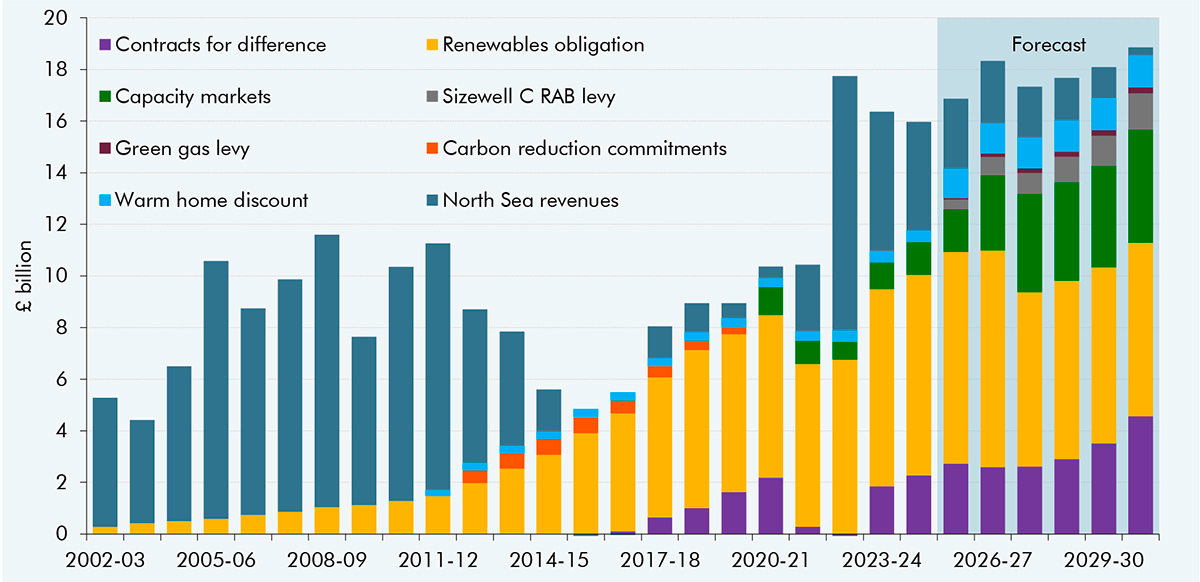
Note: The ONS have yet to include capacity market auctions or green gas levy in their outturn numbers. This chart uses outturn figures provided to us by the Department for Energy Security and Net Zero.
Source: OBR
This box was originally published in Economic and fiscal outlook – November 2025