
We have taken a more transparent approach to accounting for the supply-side impacts of policy over the past three years. This box summarised the findings and conclusions from Briefing Paper No. 10: Accounting for the supply-side effects of policy, published alongside the November 2025 Economic and fiscal outlook, which reviews our approach to incorporating such effects into our forecast.
This box is based on OBR data from November 2025 .
Since the March 2023 Economic and fiscal outlook (EFO), enhancements to our forecasts of the drivers of potential output and additional resources have enabled the OBR to more explicitly reflect the supply-side impacts of policy measures in our medium-term forecasts. In response to a recommendation from our recent external review,a we have reviewed our approach to accounting for these supply-side impacts and published our conclusions alongside this EFO (see Briefing Paper No. 10: Accounting for the supply-side effects of policy).
The paper highlights that, in the five EFOs from March 2023 to March 2025, we judged that 19 tax, spending, and regulatory policies met our supply-side criteria of: significance, additionality, durability, and evidence base (Chart A).b Their impacts were therefore incorporated into our potential output forecast. In net terms, these 19 policy measures had an average impact on the level of potential output in the fifth year of our forecast of 0.04 per cent, and a cumulative impact of 0.7 per cent.c However, there is considerable variation in the impact of individual policies. Impacts range from -0.25 per cent for the freezing of personal tax thresholds in the March 2024 EFO, to +0.2 per cent for the planning reforms in the March 2025 EFO.
Based on the review, we are making the following changes to our approach:
- Defining significance: We have clarified the definition of a ‘significant’ supply-side impact to mean that a policy, or package of measures, should be estimated to increase or decrease potential output by at least 0.1 per cent by the fifth year of the forecast (dotted lines on Chart A). Under this definition, the cumulative net impact of all six significant polices between March 2023 and March 2025 on the level of potential output after five years in our forecasts would have been 0.6 per cent.
- Tracking implementation and impact: For all policies whose supply-side effects are explicitly captured in our forecast, government departments should submit a draft monitoring and evaluation plan to the OBR at the relevant fiscal event. Plans will then be published within six months. Evaluations, as the default, will need to be concluded and published within five years of the initial scoring, with interim reports in all cases.d
- Ensuring additionality: The net impact of a policy must be additional to the effects of similar previous and existing policy programmes, after accounting for wider policy changes which may have offsetting economic effects. This is relatively straightforward for tax and welfare spending policies, as our forecasts include explicit assumptions about the counterfactual ‘pre-measures’ rates, allowances, and thresholds. It is more challenging for policies affecting departmental spending, which we generally forecast top down, and regulation, where there is no baseline forecast for the overall regulatory burden on the economy. There is therefore a heightened risk that the supply-side impact of an individual policy may be partially or fully offset by other policy changes. As such, for such policies to be judged as additional there must be a well-defined policy baseline against which the impact of the new policy can be assessed, a clearly specified funding and resource plan for the new policy, and clear evidence that the impact of the new policy will not be offset by other spending or regulatory changes.
- Developing the evidence base: There should be clear empirical and analytical support for the impact of a policy on potential output in the UK or similar countries. Where a policy has not been attempted before in the UK, its supply-side impact should be capable of quantification based on plausible mechanisms which have been empirically demonstrated in comparable contexts. The OBR will be publishing its first set of areas of research interest in the coming months, which will include areas where we have identified gaps in the literature regarding the impact of government policies on the determinants of potential output.
Chart 3A: Previously scored policies under our significance criteria
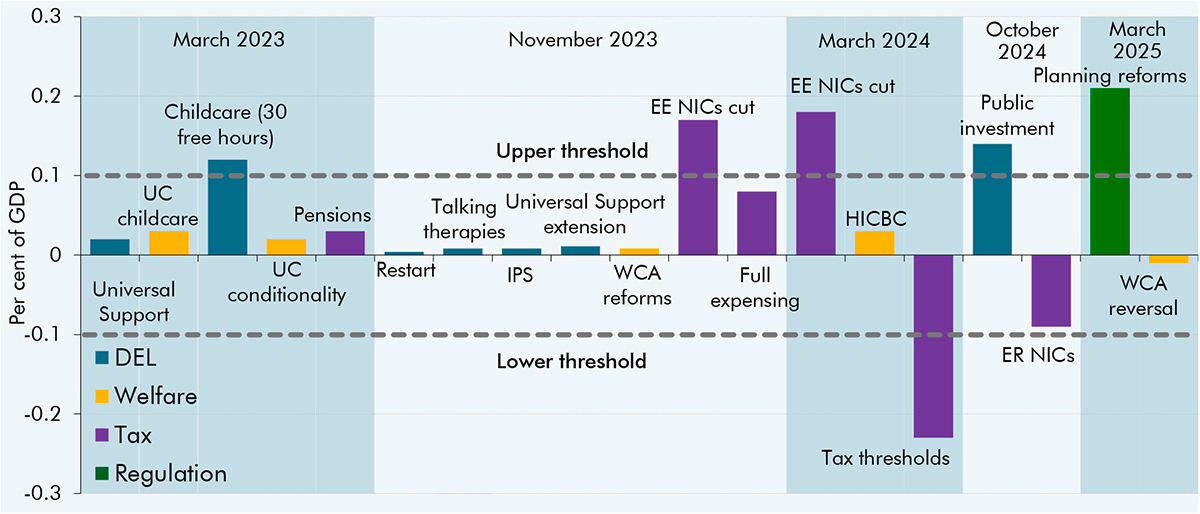
Note: Bars show the impact on potential output in the fifth year of the forecast.
Source: OBR
This box was originally published in Economic and fiscal outlook – November 2025